his is a totally "subjective" proof that is necessarily confirmed by everyone in the same
identical way. It achieves this relative universality, because reason must make
differentiation within the 'unknowable' to qualify its own potential via the limits of its
function. By so doing, it cannot help but
impose its order upon the 'unknowable' in the form of an "unknowable pre-self"
as well as an "unknowable post-self." This causes the idea of
'order
within the unknowable' to become the ultimate form of self. Still, the idea of 'order within
the unknowable' is inherently unintelligible, since it lacks temporal
reference to foundation. To overcome this problem it must be
linked to the unchanging form of itself -- or to the 'ordered
unknowable.' It is in this way that the idea of an 'ordered
unknowable' assumes to necessity for us.
As common sense would have it, it is
this idea of an 'ordered unknowable' that is
universally associated with Deity -- and rightly so -- for Deity
must admit of order in order to be known to us. At the same time,
Its capability
to manifest order must forever remain 'unknowable' for us, or else we could not
make differentiation between ourselves and It. The only idea
capable of filling this bill is that of an 'ordered unknowable.'
So what does all this mean? It
means that as a result of the way that we are forced to view the
'unknowable,' we cannot help but confirm the necessity for Deity in the
process of trying to give meaning to ourselves. Whatever the
implications that stem from this admission, it is undoubtedly a small cost
to pay for a verifiable link between succession and simultaneity.
For without that link we would be unable to conceptualize temporal relevance
at all. And yes, we can and do function without this more in depth
knowing, but once it becomes known to us, it cannot be logically denied.
From that point forward, the denial of Deity translates to the direct denial
of self.
Obviously this form of proof does not confirm the richness of
description attributed to Deity, correctly or incorrectly, by revelation, prophecy
or myth.
However, it does give reason sufficient cause to believe in an 'ordered unknowable' (an
idea central to the defining of both Deity and self) provided its use of this belief remains
logical. Anything more serves only to negate the independence of self (freewill) central
to reason's function and crucial to its belief in the determination of all else.
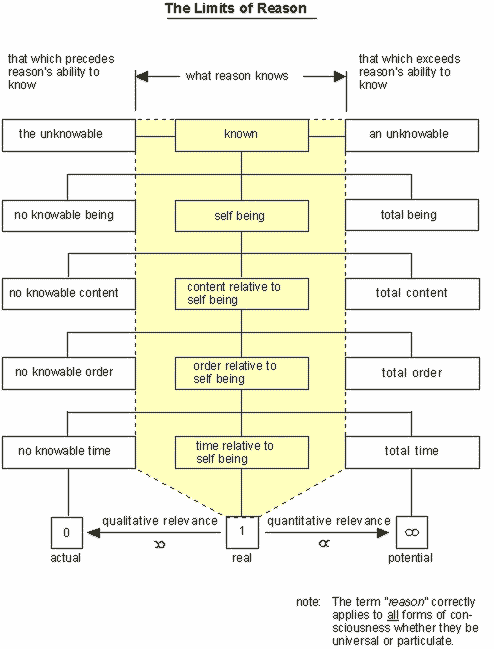
The following diagram provides a pictorial representation of the
inter-relatedness of some the more important ideas that we entertain. It also shows how
they necessarily conform to the structure which this proof illuminates
-- a structure that imposes itself upon everything about which we think.